
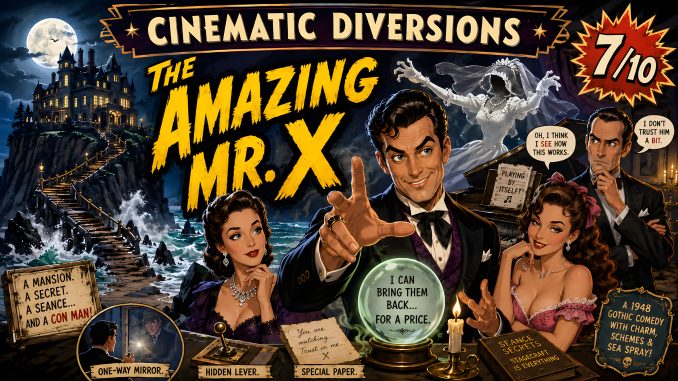
A Masterclass in Spiritual Fraud and Dead Animal Accessories
The Amazing Mr. X (The Spiritualist) (1948): 7 out of 10: The Amazing Mr. X is the second low-budget, black-and-white genre film I have watched this week that has performed considerably above its weight class, the first being 1957’s The Unearthly. This one appears to have had at least a little more money behind it. They were able to film at the Villa de Leon, also known as the Kaufmann Estate, which gives the production an enormous mansion to wander around in whenever the plot needs another cavernous hallway, dramatic staircase, or suspiciously empty room.
The cast may not be packed with instantly recognizable names, but Richard Carlson was certainly a reliable B-movie presence, while Turhan Bey continued working well into the early 1990s, including appearances on shows such as Murder, She Wrote. They are joined by Lynn Bari and Cathy O’Donnell in what is essentially a five- or six-person story involving grief, romance, spiritualism, fraud, and some very wealthy people who probably should have asked more questions before inviting mysterious strangers into their mansion.
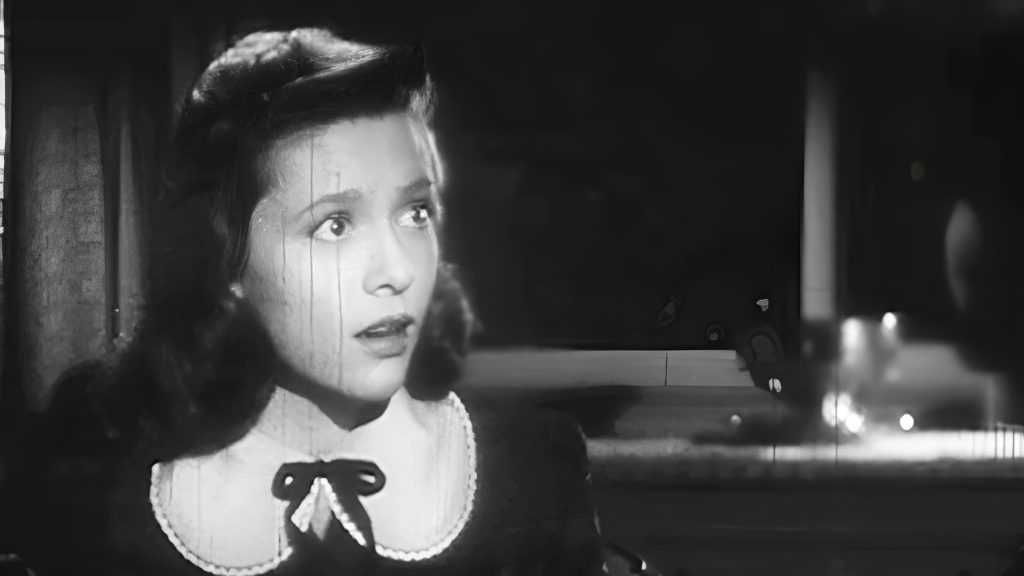
Soon the piano is mysteriously playing songs associated with Christine’s dead husband, a wedding dress appears to come alive, and Christine begins taking ominous nighttime walks along the beach beneath her mansion. Is she genuinely being contacted from beyond the grave, or is someone exploiting her grief for financial gain?
Being a 1948 thriller, the answer involves less digital ectoplasm and more trapdoors, mirrors, hidden mechanisms, and people making extremely poor decisions while dressed impeccably.
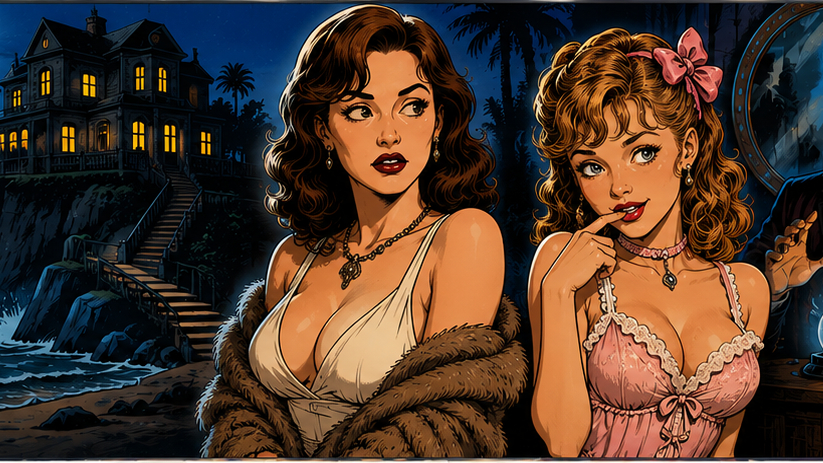
The Good
The strongest part of The Amazing Mr. X is how willing it is to explain the mechanics of the spiritualist con. The movie does not simply show Alexis performing a séance and asking us to accept that he is somehow fooling everyone. It goes into the weeds.
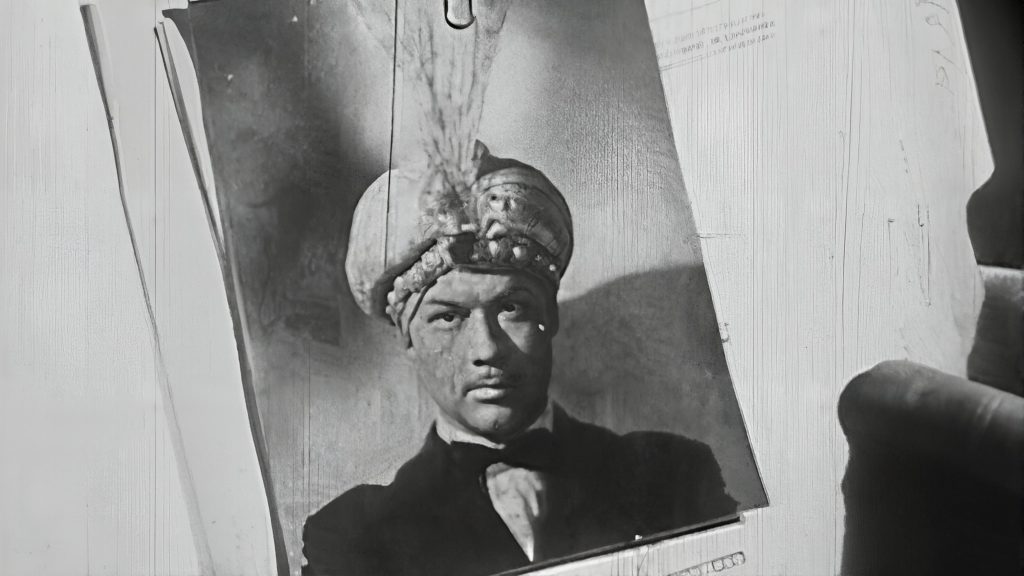
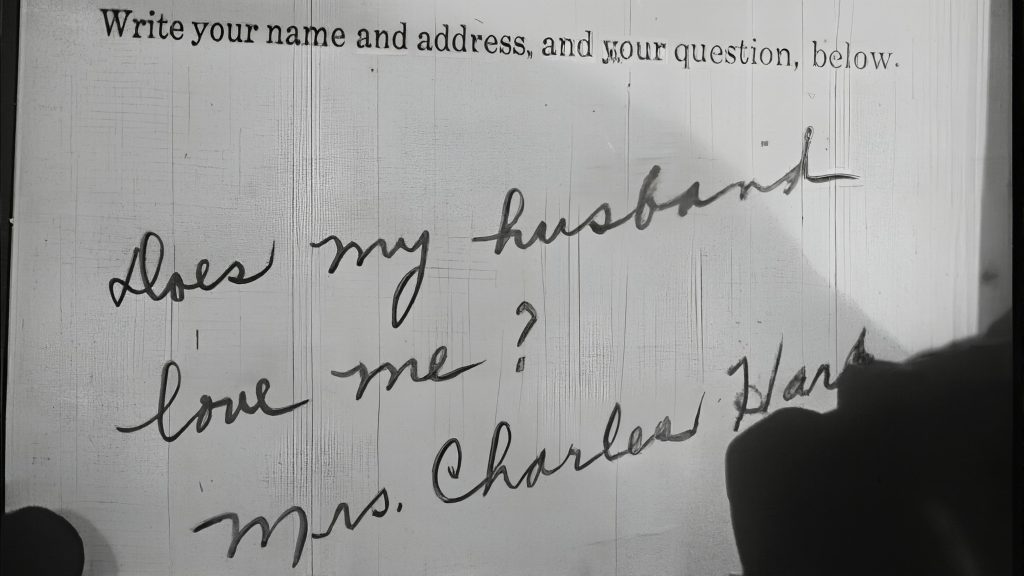
We see the one-way mirrors, the concealed levers, the specially prepared paper used to discover what clients have written, and the various methods used to create voices, music, movement, and supposedly supernatural manifestations. These details give the film a wonderful procedural quality. Watching Alexis work is almost like watching a stage magician calmly explain the trick while still managing to retain some of the magic.
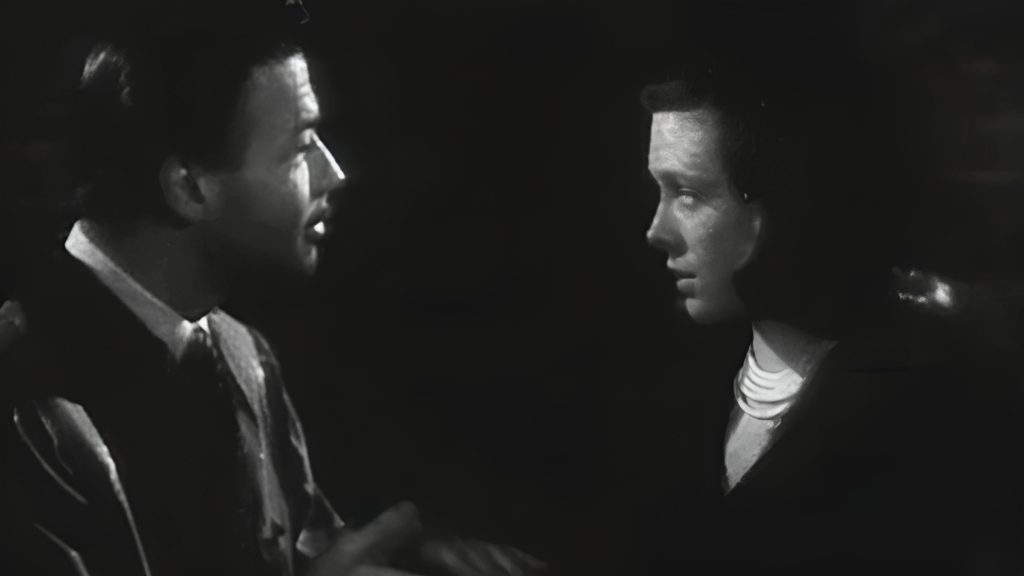
Turhan Bey is excellent in the role. Alexis is clearly a con man. He is manipulating a grieving widow, worsening her fragile mental state, and attempting to gain access to the sisters’ fortune. He also causes Janet to fall in love with him, which is probably not part of the official ethical guidelines for fraudulent séances.
Yet Bey makes him strangely likable. Alexis is intelligent, charismatic, and occasionally seems more interested in the artistry of the con than in the money itself.

He is not merely a sneering villain tying women to railroad tracks. He understands people, knows how to tell them what they desperately want to hear, and possesses enough charm that the audience can understand why both sisters are drawn into his orbit.
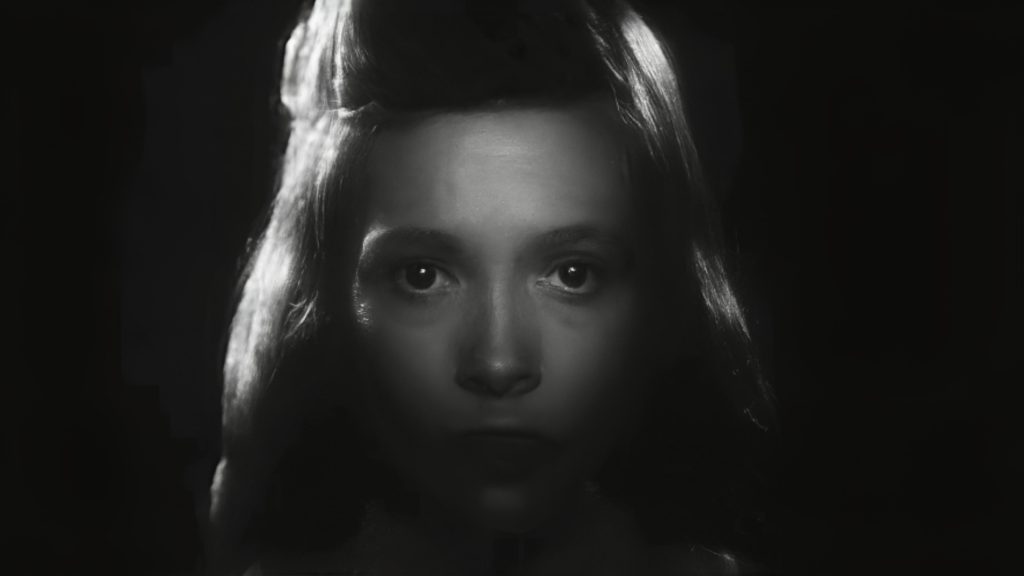
Cathy O’Donnell is another major strength. Janet shifts effortlessly between gorgeous, cute, suspicious, naïve, and spunky. She is believable as a young woman who could become fascinated by Alexis while also being clever enough to go full Nancy Drew once she senses that something is wrong.

The film also does an interesting job with the sisters’ wealth. They are not cruel or unpleasant people, but they are so insulated from ordinary life that they sometimes seem to exist in a different America from everyone else. Their mansion is enormous, their clothes are extravagant, and they appear to have very little awareness of how exposed they are to manipulation.
This does not make them deserving victims, but it does create an unusual emotional distance. You do not necessarily want to see them robbed, but you may also find yourself thinking that losing a little money might be the first practical life lesson either woman has received in years.

The acting is solid throughout, and the cinematography is frequently outstanding. The mansion is photographed as a vast, shadowy maze, and the film makes excellent use of staircases, windows, mirrors, curtains, and empty spaces. There are shots here that look far more expensive and sophisticated than the production probably was.
Most importantly, the movie has a major twist roughly two-thirds of the way through that genuinely elevates the entire story. It is properly foreshadowed, so it does not feel like cheating, but it still arrives as a complete surprise. Much like the revelation in The Unearthly, it pushes an already enjoyable little B-picture across the finish line and into recommendation territory.
The Bad
The pacing can be slow. There are stretches where characters spend an awfully long time walking through the mansion, walking down staircases, walking across the beach, or discussing whether another character should walk through the mansion, down the staircase, and across the beach.
The limited cast and locations occasionally make the film feel less like a feature and more like a very handsome stage play that someone has carefully spread across eighty minutes. The mansion is impressive, but it is also so cavernous that you begin wondering whether the characters ever use most of it or whether entire wings have remained untouched since the Coolidge administration.

The day-for-night photography is also not especially convincing. The beach scenes are supposed to take place in deep darkness, but they often look like everyone is wandering around in the middle of a cloudy afternoon and politely agreeing to pretend otherwise.
The movie’s supernatural tricks are frequently clever, but not all of them survive close inspection. The wedding dress sequence is memorable and atmospheric, although one suspects that anyone maintaining a reasonable distance from the dress and turning on a lamp would quickly reduce the terror level.

Still, these are mostly small flaws. The film moves slowly at times, but it rarely becomes dull because there is usually another piece of spiritualist machinery, suspicious behavior, or increasingly elaborate deception waiting nearby.

The Ugly
The beach. Christine has finally allowed herself to become engaged to Martin, the sensible lawyer who clearly cares for her and would probably improve her life by encouraging her to stop listening to voices coming from inside furniture.
She is supposed to be having dinner with him that evening. She dresses completely to the nines.. One assumes that her driver will take her to Martin’s house, or perhaps Martin will arrive at the mansion to collect her.
Instead, she walks down an enormous, rickety staircase stretching hundreds of feet from the mansion to the beach. She then begins wandering along the surf in formal evening wear.
I live in a Florida beach town. I am perfectly willing to believe that someone might walk along the beach to a neighbor’s house. That is not what is happening here.

This beach ends in a wall of jagged rocks and crashing waves. There is clearly nowhere to go. Christine is not taking a shortcut. She is not enjoying a pleasant seaside stroll. She is walking toward a dead end dressed like she is attending the Academy Awards.
Then Martin suddenly appears. He is wearing a tuxedo.
Why is he standing on the beach in the middle of the night wearing a tuxedo? Did he also descend a massive staircase? Was he waiting behind one of the rocks? Was his house somehow located inside the cliff? Did formalwear simply attract wealthy people to the shoreline in 1948?

I do not know why Christine went down there. I do not know how she expected to reach Martin’s house. I do not know where Martin came from. I do not know how either of them planned to return to civilization.
It is a small thing. It has almost no effect on the plot, but God help me, it drove me nuts.
In Conclusion
The Amazing Mr. X is not quite a forgotten masterpiece, but it is a remarkably effective little supernatural thriller that accomplishes far more than its modest budget and limited cast would suggest.
Turhan Bey gives the film a charismatic center, Cathy O’Donnell is delightful, Richard Carlson provides a sturdy voice of reason, and Lynn Bari convincingly portrays a woman whose grief has left her vulnerable to manipulation. The detailed séance tricks are fascinating; the camerawork is frequently beautiful, and the major late-film revelation ties the story together exceptionally well.
The pacing occasionally drags, the day-for-night photography is unconvincing, and the beach appears to operate according to laws of geography known only to wealthy people in tuxedos.
Still, this is a clever, attractive, well-acted B-movie with a genuinely strong story. It may not be a complete diamond in the rough, but it is certainly a pretty bauble.
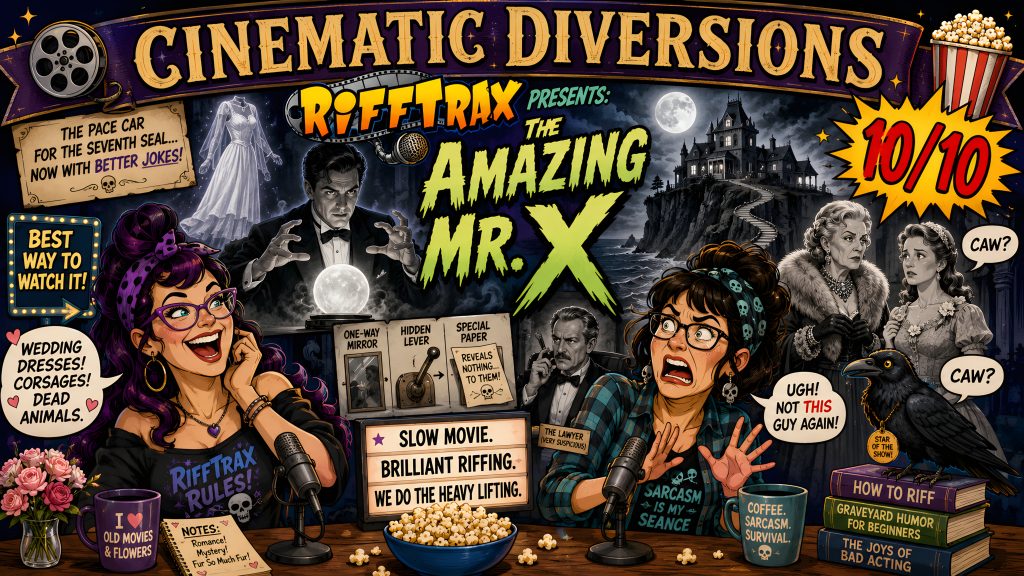
RiffTrax Presents: The Amazing Mr. X Review
RiffTrax Presents: The Amazing Mr. X (2017): 10 out of 10: Bridget Nelson and Mary Jo Pehl take on The Amazing Mr. X in what may have been their first full-length feature riff together, and they absolutely hit it out of the park. The original film is a handsome, well-acted little supernatural thriller, but it is also a very slow one. At one point they describe it as “the pace car for The Seventh Seal,” which is both cruel and remarkably accurate. This is not Grizzly, where bears are attacking helicopters, nor A Talking Cat!?!, where Eric Roberts speaks unconvincingly through a cat every couple of minutes.
The Amazing Mr. X offers long walks, mournful glances, formal wear complete with dead animal throws, and people entering enormous rooms at a stately pace. Bridget and Mary Jo take that limited material and turn it into one of my favorite RiffTrax performances.

The key is that they sound as though they are genuinely having a wonderful time. Their rapport is effortless, and the track has the comfortable feeling of watching a movie with two very funny friends who keep noticing things you missed.
Mary Jo is especially delighted by the wedding dresses, engagements, corsages, and elaborate romantic rituals, while both riffers pay close attention to the astonishing fashion choices of the female leads. There is an entire ecosystem of dead animals draped around necks in this movie, and Bridget and Mary Jo are not going to let a single pelt pass without comment.

Their perspective also gives the riff a different flavor from the usual RiffTrax lineup. They focus on social customs, clothing, relationships, and the little absurdities of how the women behave in ways the male riffers might not have noticed.
What is most impressive is how consistently they score, despite the movie rarely setting them up for an obvious knockout. They are like a particularly useful baseball player, hitting singles and doubles until suddenly the bases are loaded and the whole thing becomes a home run. Think of the Mets in the bottom of the tenth inning of Game Six of the World Series, except with more corsages and fewer ground balls rolling through Bill Buckner’s legs.

Even the film’s raven becomes a running source of comedy, largely because Bridget appears to hate the bird with the passion of a thousand suns. That hostility is especially amusing if you have heard the occasional stories on 372 Pages We’ll Never Get Back about Mike Nelson and Bridget’s battles with neighborhood birds. I may be connecting dots that were never meant to be connected, but the raven certainly seems to awaken something deep within her.
RiffTrax Presents: The Amazing Mr. X is an excellent example of how great riffing does not require a terrible movie or an endless procession of on-screen madness. Sometimes all it takes is sharp observation, strong chemistry, and two performers who are clearly delighted to be in the room together.

Bridget Nelson and Mary Jo Pehl elevate an already enjoyable film into something warmer, funnier, and far more re-watchable. It is a terrific introduction to their style, a wonderful showcase for RiffTrax Presents, and unquestionably the best way to watch The Amazing Mr. X.