
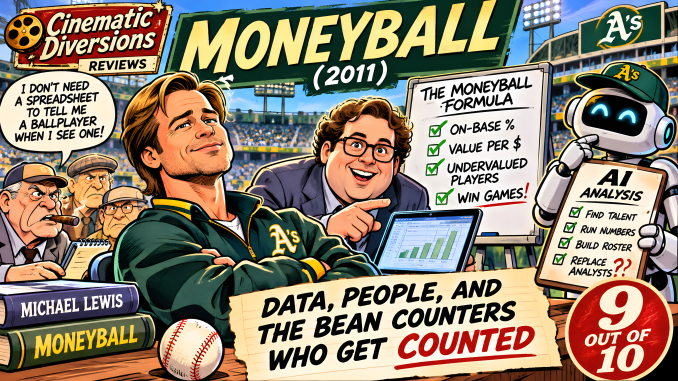
Feel Like a Number
Moneyball (2011): 9 out of 10: Yay! It’s a movie based on a Michael Lewis book! I like Michael Lewis. I genuinely do. I’ve been reading him since the late 1980s, and I feel a certain kinship with the man. We have somewhat similar backgrounds, except he has an education, a work ethic, and a successful writing career. Other than those minor distinctions, we’re practically twin flames.
Lewis has an extraordinary talent for finding fascinating stories in subjects that should be spectacularly boring. Bond trading, mortgage-backed securities, financial markets, and now baseball statistics. These are not necessarily topics that have audiences lining up around the block for movie tickets. Yet Lewis finds the human stories lurking beneath the numbers.

And Moneyball is a particularly interesting example because the world has changed considerably since Lewis wrote the book in 2003, and even more since this film appeared in 2011.
But first, the movie. Brad Pitt plays Billy Beane, general manager of the Oakland Athletics, a professional baseball team operating on a budget that wouldn’t cover the New York Yankees’ catering expenses. Following the 2001 season, the Athletics lost several of their best players to wealthier franchises, leaving Beane with the unenviable task of assembling another competitive team without the money traditionally required to purchase one.

Enter Peter Brand (Jonah Hill), a young economist who believes that baseball’s traditional methods of evaluating players are fundamentally flawed. Rather than judging athletes by their appearance, reputation, or conventional statistics, Brand proposes identifying undervalued players through a different approach to statistical analysis.
Beane embraces the methodology, much to the horror of his veteran scouts and manager Art Howe (Philip Seymour Hoffman). The results are initially less than encouraging, but as the season progresses, Oakland begins demonstrating that perhaps a baseball team can be assembled using mathematics rather than the accumulated wisdom of elderly gentlemen who have spent forty years watching men hit balls with sticks.

The Athletics eventually embark on a remarkable twenty-game winning streak, setting an American League record and demonstrating that there might be something to this numbers business after all.
Now, I’m going to get the filmmaking praise out of the way early because what interests me most about Moneyball is considerably larger than baseball.

The acting is top-notch. Brad Pitt is excellent as Billy Beane, and he even bears a reasonable resemblance to the actual man. Philip Seymour Hoffman is equally convincing as Art Howe, both physically and in his portrayal of a veteran manager who understandably resents having his professional judgment questioned by people with calculators.
Jonah Hill is terrific as Peter Brand, a fictionalized character inspired by real-life executive Paul DePodesta. Hill manages to make a statistics-obsessed assistant general manager an interesting and sympathetic character. This is no small achievement. Most movies would have made him a serial killer.

The filmmakers also deserve considerable credit for recreating the baseball itself. The stadiums, crowds, players, uniforms, and games look remarkably authentic. The production uses actual baseball footage alongside carefully staged recreations, and the combination is practically seamless.
There are Hollywood liberties, of course. The movie simplifies Oakland’s success considerably, especially by giving relatively little attention to the extraordinary pitching talent already on the team. But the major events are real, including that twenty-game winning streak.

This isn’t Patch Adams, where Hollywood apparently decided a fictional woman needed to be invented to provide some additional tragedy. Nor is it Braveheart, where a famous battle involving a bridge is recreated in the middle of a field conspicuously lacking a bridge. The filmmakers take the underlying history seriously, and it shows.
But what I particularly appreciate about Moneyball is its depiction of an industry confronting change.
There are some absolutely wonderful scenes involving Beane and the veteran baseball scouts sitting around a conference table discussing potential players. These men evaluate athletes based on the physical appearance to their girlfriends and how that reflects on their confidence, and perceived character. Their assessments are delivered with absolute conviction despite frequently having little objective basis.

These scenes are hilarious, and they are also painfully familiar. Anyone who has worked in an established industry for any length of time has encountered these people. The old guard. The institutional memory. The veterans who have been doing things a particular way since the Carter administration and see no compelling reason to stop now.
We’ve always done it this way. That sentence has probably cost the American economy more money than organized crime.
And baseball is the perfect setting for this conflict. Here is an industry absolutely drowning in tradition, stretching back more than a century, where the accumulated wisdom of generations of scouts and managers has become practically sacred.

Then along comes some young fellow with a computer who suggests that perhaps we should examine whether any of this accumulated wisdom actually works. You can practically hear the aneurysms forming.
The wonderful thing about these scenes is that they aren’t merely about baseball. They could take place in practically any industry. Manufacturing, banking, retail, education. Universities may be among the last great sanctuaries of this particular philosophy, where tradition can be defended with the sort of religious fervor normally reserved for medieval monasteries.

But here’s where Moneyball gets interesting.
Billy Beane is the hero of this movie. And Billy Beane is a bean counter.
Literally, in a sense. His name is Beane, and his entire philosophy involves reducing human performance to numbers. Think about that for a moment.
How often have we heard people complain about bean counters? The accountants and analysts who don’t understand the human element. The executives who reduce employees to productivity statistics. The corporate managers who make decisions based entirely on spreadsheets without considering the people represented by those little boxes.

We’ve all encountered them. We shake our fists at them. We complain that they don’t understand the business. We insist that there are important qualities that cannot be quantified.
And yet here is Billy Beane, doing precisely what we accuse these people of doing, and we’re cheering him on. He’s not particularly concerned about whether a player looks like a baseball player. He’s not interested in whether the man has a beautiful swing, can steal bases, or impresses a scout with his athleticism. He wants to know whether the player produces the statistical results necessary to win baseball games.
The individual becomes a collection of numbers. And somehow, this is revolutionary and not a Bob Seger song from 1978.

Now, before anyone mistakes this for an argument against statistical analysis, let me make something clear. Billy Beane is right. Or, more precisely, he’s right to question whether the traditional methods of evaluating players are actually producing the results everyone assumes they are.
The old scouts are making subjective judgments based on experience, intuition, and frequently some rather questionable assumptions about human behavior. Beane and Brand are using actual performance data to test those assumptions.

There’s nothing wrong with that. Quite the opposite. Numbers can reveal inefficiencies, challenge prejudice, and identify talent that might otherwise be overlooked.
Indeed, that’s one of the most appealing aspects of the story. Players who have been dismissed because they don’t look right, are too old, or possess some perceived deficiency suddenly become valuable because somebody has bothered to examine what they actually accomplish.

There’s something almost egalitarian about that. But here’s the distinction that makes this movie so fascinating when viewed today.
In baseball, the objective is relatively straightforward. You want to win games. You need players who contribute toward that objective, and you have a limited amount of money with which to acquire them. If a particular statistic helps identify players who contribute more wins per dollar spent, that’s extremely useful information.
And we’ve become extraordinarily comfortable doing exactly that. Think about the modern workplace.

Employee productivity, customer satisfaction, sales conversion, attendance, efficiency, performance targets. Practically everything is measured. Somewhere, somebody is examining a spreadsheet and deciding whether the numbers in the little boxes indicate that the people represented by those boxes are doing their jobs properly.
Sometimes they are. Sometimes they’re measuring the wrong things. Sometimes they’re measuring the right things but interpreting them incorrectly. And sometimes the people doing the measuring have absolutely no understanding of the work being measured.

An employee may produce excellent numbers while being terrible at the job’s less easily measured responsibilities. Another employee may produce mediocre numbers while doing a dozen valuable things that never appear on a report.
Neither possibility makes statistical analysis useless. It simply means that the statistics require interpretation and context. And there’s a difference between using data to understand people and using data as an excuse to stop understanding them.

That’s the contradiction at the heart of Moneyball. When Billy Beane uses statistics to challenge the establishment and give overlooked athletes an opportunity, he’s a visionary.
When a corporate executive uses precisely the same philosophy to decide that an employee isn’t producing sufficient value to justify his salary, he’s the villain.

The mathematics hasn’t necessarily changed. What has changed is our perspective. We’re delighted when statistical analysis reveals that somebody else is making irrational decisions. We’re considerably less enthusiastic when statistical analysis suggests that we might be the ones making irrational decisions.
And we’re even less enthusiastic when those statistics threaten our livelihoods.
It’s not necessarily hypocrisy. There are important differences between evaluating athletes for a competitive sports franchise and deciding whether ordinary employees deserve to keep their jobs. But the tension is real, and the movie presents an unexpectedly useful opportunity to think about it.

It reminds me a little of Wall Street. Gordon Gekko is technically the villain of that movie, but let’s face it, he’s the character everybody remembers. He’s the charismatic financial genius who sees the world differently from everybody else and makes an absolute fortune exploiting that difference. And, I hate to say this, Gordon Gekko was right.
Of course, Wall Street also embraces the absurd Hollywood notion that wealthy investors buy struggling companies and dismantle them because their assets are worth more than the operating business. Imagine such a thing happening in real life!

What interests me is that both films revolve around people who recognize that the conventional wisdom of an established industry contains enormous inefficiencies.
And both raise the question of what happens when those inefficiencies involve actual human beings.
Which brings us to artificial intelligence. If Billy Beane was a revolutionary in 2002, what exactly would he be in 2026?
The statistical analysis performed by Beane and Brand was extraordinarily innovative at the time. Today, enormous amounts of information can be processed by computer systems in seconds. Artificial intelligence can identify patterns, compare variables, generate projections, and examine relationships that would once have required teams of analysts working for weeks.

Imagine Peter Brand sitting at his desk with access to modern AI systems. He could probably accomplish a substantial portion of his analytical work before finishing his morning coffee.
Of course, interpreting those results, making decisions, negotiating contracts, and dealing with actual human beings would still require considerably more judgment. At least for now.

But there’s a wonderful irony here. The entire premise of Moneyball involves identifying people whose economic value has been misunderstood because their employers are using outdated methods of evaluation.
And now we’re developing technology that could apply the same analytical philosophy to the people who pioneered it.
Suppose somebody examines the Oakland Athletics’ front office and discovers that much of the statistical analysis can be performed by software at a fraction of the cost. What happens to Peter Brand? What happens to Billy Beane? The bean counters get counted.

And there’s another complication. Once every baseball team begins employing sophisticated statistical analysis, the competitive advantage of using that analysis starts to disappear.
If everyone knows that on-base percentage is undervalued, it isn’t going to remain undervalued for very long. The market adjusts.
This is something Michael Lewis understands particularly well, having spent so much of his career writing about financial markets. Finding an inefficiency is wonderful. Finding an inefficiency that everyone else has already discovered is considerably less profitable.

In other words, Moneyball isn’t ultimately about finding the perfect statistic. It’s about recognizing that the conventional methods of evaluating something might be wrong.
And being willing to change them. Which makes the current state of professional baseball rather amusing.
The 2026 World Series featured the Tampa Bay Rays and Milwaukee Brewers, two teams operating with payrolls well below those of baseball’s wealthiest organizations. Milwaukee entered the postseason with the nineteenth-highest payroll in baseball, while Tampa Bay was down near the bottom of the league.

Milwaukee won the World Series, demonstrating that you don’t necessarily need the largest checkbook in the sport to win a championship.
Meanwhile, the New York Mets entered the regular season with baseball’s largest payroll and didn’t make the playoffs at all. Clearly, not everybody has received the memo.

But this also illustrates the limits of the original Moneyball revolution. Statistical analysis doesn’t magically eliminate economic disparities. Wealthy teams can hire the best analysts, purchase the same software, and still spend considerably more money acquiring players.
The advantage shifts. The methodology evolves. Everybody looks for the next inefficiency. Which is precisely what happens in business.

And perhaps this is the most important lesson hiding beneath all those baseball statistics. The question isn’t simply whether we should use numbers to evaluate people. Of course, we should when the numbers tell us something useful.
The question is whether we’re measuring the right things, whether we’re interpreting the results intelligently, and whether we understand the limitations of what those numbers can tell us.

A spreadsheet isn’t inherently wise simply because it contains mathematics. And an executive isn’t necessarily intelligent simply because he knows how to read one.
Now, returning to the actual film, there’s another aspect of Moneyball that deserves considerable praise. It allows its scenes to breathe. I cannot tell you how wonderful that is.

Characters sit in rooms and have conversations. They pause. They think. They listen to one another. Sometimes absolutely nothing dramatic happens for an extended period, and the movie is perfectly comfortable with that.
We visit players in their homes. We meet wives and children. We see people dealing with ordinary problems. We learn about them through conversation rather than having their personalities explained to us in thirty seconds of frantic exposition.

In fact, there’s a lovely irony in a film about reducing people to statistics taking so much time to show us the human beings behind those statistics.
Billy Beane himself isn’t presented as some emotionless accounting machine. He’s a former player whose career didn’t fulfill its considerable promise. He understands the human cost of the decisions he makes, even when he tries to maintain some distance from the players.

The film understands something that the less thoughtful advocates of statistical management sometimes forget. People aren’t numbers, even when numbers can tell us useful things about people.
And the film trusts its audience to appreciate that distinction without having somebody explain it in a motivational speech.
I recently watched the 2026 adaptation of Wuthering Heights, a movie that somehow managed to eliminate enough characters from the original story that the remaining cast couldn’t field one side of a baseball game.

Despite this remarkable economy of personnel, the film never seemed interested in allowing its characters sufficient time to develop into actual human beings.
Everybody was constantly doing something, saying something dramatic, or participating in a scene designed to generate an immediate emotional response. And yet I came away knowing remarkably little about most of them.
Moneyball is almost the opposite.

There are long stretches of people simply talking about baseball. Sometimes they’re talking about statistics. Sometimes they’re talking about their families. Sometimes they’re arguing about decisions that won’t pay off for weeks or months.
And somehow, this is more compelling than a movie that seems determined to deliver an emotional climax every seven minutes. It’s an adult film. Made for adults.

One suspects that a less confident studio executive examining Moneyball might suggest shortening the conversations, adding more baseball action, inserting a romantic subplot, and perhaps giving Peter Brand a hilarious best friend who falls down occasionally.
Fortunately, director Bennett Miller and screenwriters Steven Zaillian and Aaron Sorkin have considerably more respect for their audience.

The movie isn’t perfect. There is an inherent shortage of suspense when you’re watching a historical drama about a famous achievement. We know that Beane’s approach is going to produce something remarkable because otherwise Michael Lewis probably wouldn’t have written a book about it, and Hollywood certainly wouldn’t have spent millions of dollars adapting that book.
Moneyball is intelligent, thoughtful, beautifully acted, and exceptionally well constructed. It takes a subject that could have been unbearably dry and turns it into a compelling examination of tradition, economics, human judgment, and institutional resistance to change.

More importantly, it has become a more interesting movie with age. In 2011, Billy Beane represented the future. The man who understood that data could tell us things intuition could not. In 2026, we live in that future, and some of us are beginning to wonder whether we’ve taken the whole numbers business a little too far.
And that’s what makes Moneyball such a fascinating film to revisit.
Billy Beane understands that the old scouts have mistaken their subjective impressions for objective truth. The danger for those following in his footsteps is making precisely the same mistake with spreadsheets.

And perhaps that’s the real achievement of Moneyball. It doesn’t set out to answer all these questions, but it provides an excellent starting point for considering them. While watching grown-ups behave like grown-ups.
Should have had a Bob Seger song in the closing credits though…
A stranger in this land
I feel like a number
I’m not a number
I’m not a number
Dammit, I’m a man
I said I’m a man